the Major Gifts Pyramid
What Is A Major Gifts Pyramid?
A major gifts pyramid is a planning tool that helps nonprofits estimate how many gifts they'll need at each giving level to reach a fundraising goal. Rather than hoping a few large donations appear, a gift pyramid starts with the end in mind, mapping out a combination of leadership, major, mid-level, and grassroots donations needed to achieve a revenue target.
A well-designed major gifts pyramid helps organizations set achievable goals, identify gaps in their donor pipeline, and focus cultivation efforts where they will have the greatest impact.
The calculator below generates a major gifts pyramid based on your fundraising goal. While every organization's donor base is different, the underlying principle remains the same: transformational fundraising is done intentionally, not accidentally.
Why Gift Pyramids Work
Gift pyramids have been a cornerstone of major gifts fundraising for decades because donor giving naturally follows a highly uneven distribution. In virtually every fundraising program, a relatively small number of donors contribute a disproportionately large share of revenue, while many more donors give at lower levels.
Campaign planning methodologies promoted by organizations such as the Association of Fundraising Professionals (AFP), fundraising consulting firms, and leading fundraising practitioners have long relied on gift charts to estimate the number and size of gifts required to achieve fundraising goals. Although no two organizations have identical donor distributions, planning from a gift pyramid encourages fundraisers to build a diversified revenue strategy instead of depending on a handful of unlikely gifts.
Perhaps most importantly, a gift pyramid forces organizations to answer an often-overlooked question: “Do we actually have enough qualified prospects to achieve this goal?”
how to use the Calculator
-
Start with the total funding your organization aims to raise this year through major gifts. This might be a top-down, board-approved major giving goal, or it could simply be what you’re hoping to achieve through your relationships with major donors. It really just depends on what led you here, to this tool.
-
The “Pipeline Structure” field in this calculator relates to the structure of your major gifts pipeline (the donors, prospects, and donations you are actively pursuing or planning to pursue this year).
Balanced: A common, healthy structure with a few transformational gifts at the top, a more moderate middle tier, and a broader base at the lower end of the major gift threshold. Best for established programs with a breadth and depth of major gifts experience across major gift levels.
Top-Heavy: A few very large gifts at the top make up most of your major giving, but you still have some middle-tier and lower-end major donors. Relies heavily on strong relationships with your highest-capacity donors, but poses a greater risk if one or two of your top gifts fall through.
Broad Base: Your organization’s major giving program exists mostly at the lower end of the major gift threshold, but there are quite a few moderately sized major gifts and maybe even a transformational gift or two. Spreads risk across more donors but requires more activity and volume.
Custom: Fully editable. Just select custom and adjust the table (as described below under “Adjust the Table”).
-
Remember: this is a Major Gifts Pyramid Calculator, and a true pyramid has a small, narrow peak at the top and expands as it moves downward into a broader base.
Following that logic, your Major Gifts Pyramid should look like this:
The largest major gift amounts belong at the top. These are the biggest gifts your organization could reasonably receive — transformational gifts that would meaningfully move your mission forward. They should be ambitious but defensible: amounts you genuinely intend to ask for and believe are supported by donor capacity and relationship strength. Because these gifts are large, they typically require the most cultivation time, strategic engagement, and leadership involvement. Your timeline to close them — and your team’s capacity to steward relationships at this level — are critical considerations.
As you move down the pyramid, the number of gifts increases. Gift amounts decrease at each tier, but the volume increases. While individual gifts are smaller, the total revenue contributed by each tier often remains significant. This widening structure reflects a fundamental principle: the higher the gift amount, the fewer donors can make it; the lower the amount (within your major gift range), the more donors can realistically participate.
The smallest major gifts form the base. This is your organization’s major gift threshold — the lowest donation level at which you classify someone as a major donor. Many organizations use $10,000 as a common industry benchmark, but your threshold should align with your mission, donor base, and internal capacity. The base of the pyramid is important because it distributes risk. A broader base means more donors contributing at meaningful levels, creating greater stability and resilience in your revenue.
If your pyramid does not widen toward the bottom, you are concentrating risk among too few donors. When it widens appropriately, revenue risk is spread across a larger pool — which makes your major gifts program more sustainable and less vulnerable to the loss of a single large gift.
-
The table is this Major Gifts Pyramid Calculator is fully adjustable. You can change any of the fields, as follows:
Gift Amount: A realistic target ask amount for your organization at each tier.
For the top tier, this represents the highest ask you plan to make — and could reasonably achieve — with at least one major donor this year. For example, a larger organization might model a top-tier ask of $500,000, while a smaller organization might consider $50,000 to be transformational.
For the bottom tier, this is your organization’s major gifts threshold — the lowest donation amount at which you would still classify someone as a major donor. In other words, this is whatever your organization defines as a “major gift.” The commonly cited industry benchmark is $10,000; if you follow that definition, $10,000 would be your bottom-tier amount.
Between the top and bottom tiers, include intermediate gift levels at intervals that make sense for your organization’s donor base, capacity, and strategy.
# Gifts Needed: The number of gifts at each level that your organization would need to — and realistically believe it could — close in order to reach your annual major gifts target. These assumptions should be informed by historical performance, pipeline depth, and cultivation capacity.
Tier Names: These are simply labels for your top, middle, and bottom gift levels. You may rename tiers to match your organization’s internal or external structure — whether that’s functional (e.g., “Transformational,” “Leadership,” “Major”) or branded (e.g., “Gold,” “Silver,” “Bronze”). You can also keep the alphabetical labels for simplicity.
You may also remove a row if you do not need as many gift amount tiers as the table provides you to start with, or add a row if you need more gift amount tiers.
-
Review your outputs as the Major Gifts Pyramid Calculator updates in real time:
Tier + Cumulative Revenue: Does your structure actually add up to your annual major gifts target? If the math doesn’t work on paper, it won’t work in practice.
Prospects Needed by Tier: A rule-of-thumb estimate of how many qualified prospects you likely need behind each gift level. In most major gifts programs, you will need multiple qualified prospects for every one gift you plan to close — often three to five, depending on your close rate, timeline, and relationship strength.
If your structure requires more top-tier prospects than you currently have, that’s not necessarily a problem, because it provides you with some clarity. It gives you some insight into what must be built — pipeline depth, cultivation strategies, leadership engagement — for the revenue to be sustainable and repeatable.
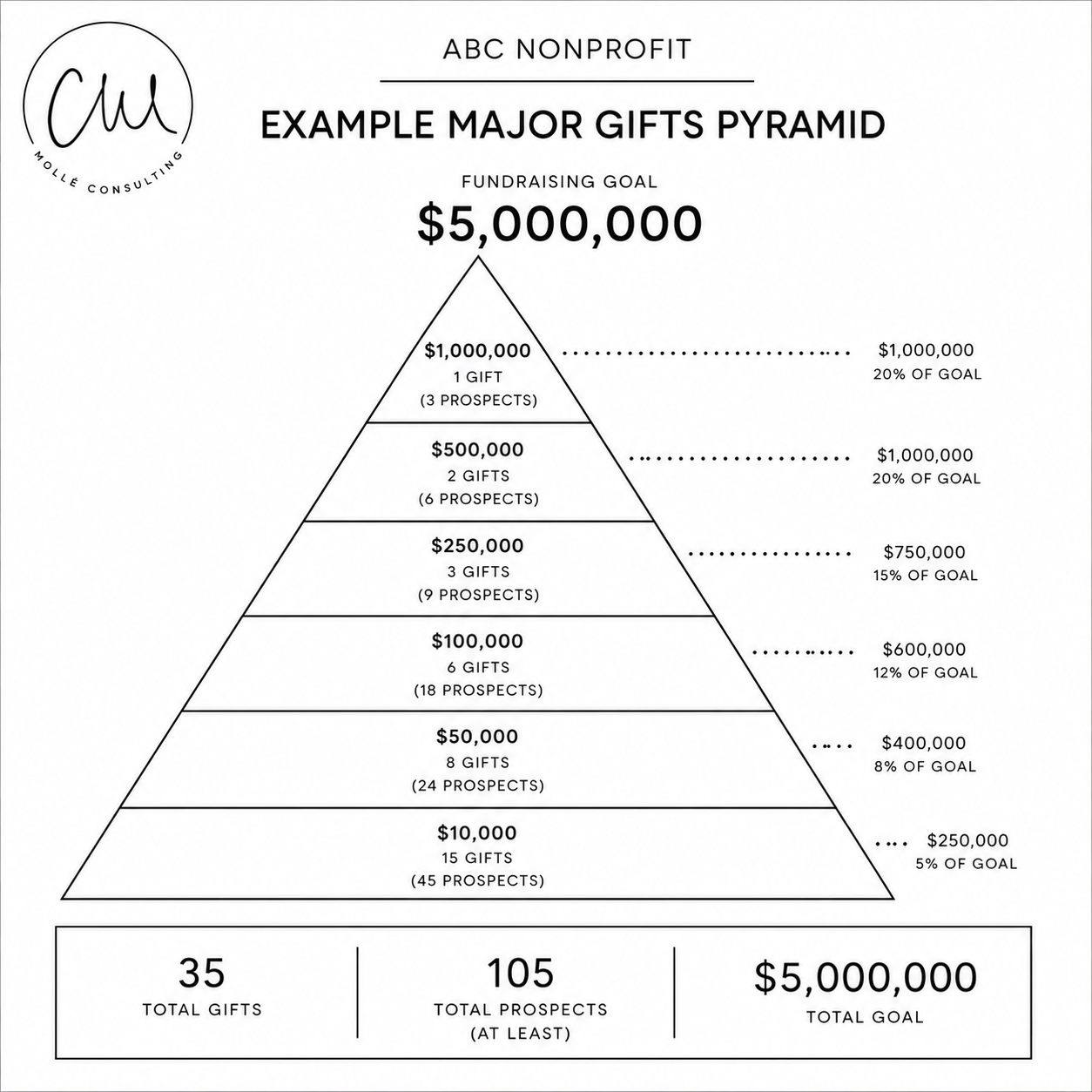
Why You Need a Minimum 3:1 Prospect-to-Gift Ratio
Just because your campaign requires ten $25,000 gifts does not mean identifying ten prospects with the capacity to give $25,000 is enough.
Some prospects will decline. Others may give at a different level than anticipated. Some won't be ready this year.
For that reason, experienced fundraisers recommend maintaining at least three qualified prospects for every gift you hope to secure at each level of your pyramid. This 3:1 ratio creates a healthy pipeline and significantly reduces the risk that your fundraising goal depends on a small number of uncertain outcomes.
For example:
Need 2 gifts of $100,000? Identify at least 6 qualified prospects.
Need 8 gifts of $25,000? Build a pipeline of at least 24 qualified prospects.
Need 20 gifts of $10,000? Cultivate at least 60 qualified prospects.
Many organizations, particularly those launching a new major gifts program or campaign, may choose to work from a more conservative 4:1 or even 5:1 ratio to create additional flexibility. The stronger your prospect pipeline, the more resilient your fundraising strategy becomes.
| Major Donor Tier | Gift Amount | # Gifts Needed | Tier Revenue | Prospects Needed | |
|---|---|---|---|---|---|
| Total Modeled Revenue | $0 | 0 | |||
| Status | On Target | ||||